
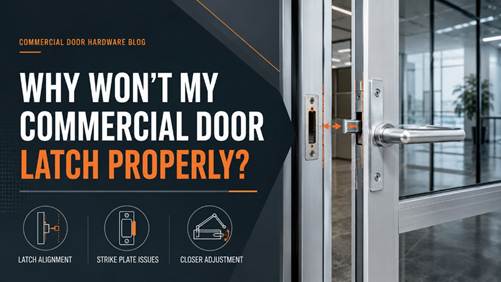
A commercial door that closes but does not latch creates more than an annoyance. Employees may assume the entrance is secure when the latch has never entered the strike. Air conditioning can escape, access control may show a misleading status, and a fire rated opening may not perform as intended.
The cause is often mechanical rather than electronic. A careful inspection can separate a simple alignment issue from a failing closer, worn hinge or damaged locking component.
Check Where the Latch Meets the Strike
Close the door slowly and watch the latch as it approaches the strike plate. If it lands above, below or beside the opening, the door is out of alignment.
The strike itself may be loose, bent or damaged. Repeated slamming can enlarge screw holes and allow the plate to move. The door frame may also have shifted slightly over time. Filing the opening without finding the cause can create a temporary result while leaving the original movement uncorrected.
A technician will check the door position first, then determine whether the strike needs adjustment or replacement.
Look for Sagging Hinges or Worn Pivots
Heavy commercial doors place considerable force on hinges and pivots. As those parts wear, the latch side of the door can drop just enough to miss the strike.
Uneven gaps around the frame are a useful clue. A narrow gap at the top hinge side and a wider gap at the opposite corner often indicates movement. Loose fasteners, worn bearings and damaged continuous hinges can produce similar symptoms.
This is not a good problem to solve by forcing the door. Continued use can damage the frame, scrape the threshold and place more strain on the closer.
Inspect the Door Closer
The closer controls how the door moves through most of its swing and during the final approach to the latch. If the door stops a few inches short, closes too gently or slams and bounces back, the closer may need professional adjustment.
Oil around the closer body or running down the door can indicate a failed seal. A loose arm, damaged mounting point or incorrectly selected closer may also prevent reliable closing.
Turning adjustment valves without understanding their limits can make the door unsafe or difficult to use. Accessible doors must meet applicable opening force and closing speed requirements, so increasing spring power is not always the correct answer.
Consider Air Pressure and Weather Conditions
A door may latch normally when the building is quiet but fail during busy hours. Strong air conditioning, exhaust systems or another open exterior door can create a pressure difference that the closer must overcome.
Arizona dust can also collect around latch bolts, thresholds and exposed hardware. Summer heat or monsoon conditions may reveal an existing alignment problem, although weather is rarely the only cause.
Notice when the failure occurs. If the problem changes with HVAC operation, wind direction or another door opening, tell the service technician. That pattern can shorten the diagnosis.
Check Access Control and Electric Hardware
An access controlled opening adds more possible failure points. An electric strike may remain in the wrong position, a latch bolt may bind, or door alignment may prevent the access control hardware from securing the opening.
Do not assume the card reader is responsible simply because the door uses badges. The reader may approve access correctly while the mechanical latch never engages.
Test the door according to the building’s security procedures and record what happens. Avoid bypassing the system or leaving the door propped open.
Repair the Problem Before It Becomes a Security Risk
A door that sometimes latches is not dependable. The problem can worsen as hinges, strikes and closer components continue to wear. Fire rated doors, exit doors and controlled entrances should receive prompt attention from qualified personnel.
C&I Show Hardware and Security Systems, Inc. installs and services commercial doors, locks, door closers, access control systems and related hardware throughout the Phoenix area and Northern Arizona. For help diagnosing a commercial door that will not latch, call the Tempe office at 480 967 8568, the Prescott office at 928 237 4556 or toll free at 800 678 8568.
References
https://cishowhardware.com/commercial-products.htm
https://kc.allegion.com/kb/user-question/door-closer-will-not-latch-door/
https://www.vortexdoors.com/blog/how-to-fix-a-door-that-wont-latch
https://www.access-board.gov/ada/guides/chapter-4-entrances-doors-and-gates/
https://www.locksmithledger.com/door-hardware/article/10938125/solving-commercial-door-problems